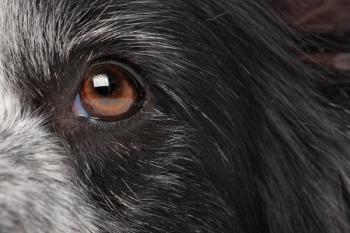
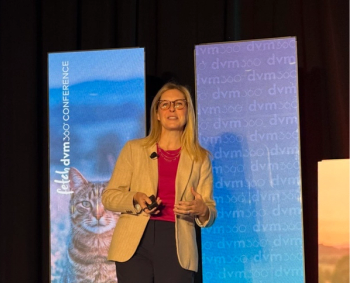
During an interview with dvm360 prior to the Fetch Long Beach Conference in Long Beach, California, Jennifer Sheahan, DVM, DACVO, recounts cases where dietary indiscretions, such as feeding a dog fatty foods, have led to acute eye conditions like milky, cloudy eyes, which can be mistaken for cataracts, the eye's leaky blood-eye barrier, which allows dietary substances to affect the eye post-surgery, and more.
Below is a partial transcript
Jennifer Sheahan, DVM, DACVO: So, there are certain conditions that we see in dogs. For example, you might see an acute case where [the client says], 'oh my gosh, we woke up this morning and my dog is blind. His eyes look like a zombie, [his eyes are] completely clouded over.' And then we look at them and it's just like milky, cloudy white color... And, oftentimes, part of the history question taking is 'Hey, did you feed a fatty meal last night? Did he get into any of the garbage?' And they're like, 'yeah, actually, you know, I gave them some of my In-N-Out.' You'd be surprised with diabetic patients. I used to think [clients] would control what [their pets] eat. They can't eat fatty foods, and it can throw off their diabetes.
I had a client that had cataract surgery, and then, the next day, they came back in and... they were like, 'we woke up and my dog's blind again, and the cataracts came back.' I was like, 'that's impossible.' What happened? So, they came in and we see them the day after surgery always, and I was like, 'Oh my God, there's so much fat inside the eyeballs.' And [I asked] 'did your dog have any super fatty foods?' And [they said], 'well, we wanted to celebrate the new eyes and give them a treat. So we gave Muffin,' our diabetic dog, 'In-N-Out on the drive home.' And I [said], 'oh, yeah, definitely don't do that. He's diabetic.'